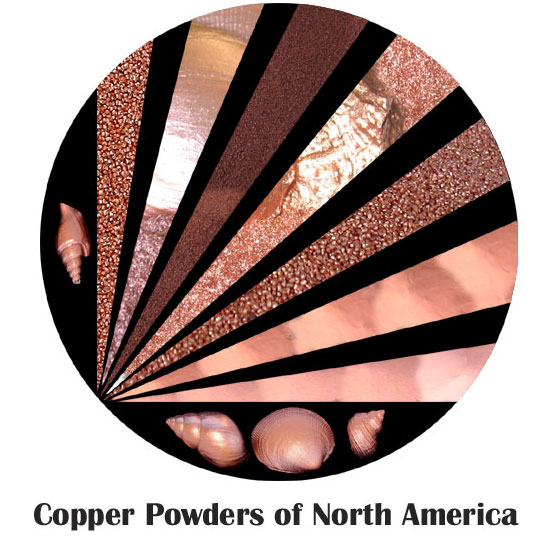
Copper powders are widely used in industrial coatings and paints to impart electrical and thermal functionality, anti-fouling behavior, decorative effects, and enhanced durability. By selecting the appropriate particle shape, size distribution, and surface characteristics, copper powders can be tailored to meet performance requirements across solvent-based, water-based, and powder coating systems.

Typical Coatings & Paints Applications
Conductive & Static-Dissipative Coatings
Copper powders are incorporated into coatings to provide:
- Electrical conductivity
- Static charge dissipation
- Grounding pathways
- EMI/RFI attenuation
These coatings are used on:
- Plastic housings and enclosures
- Industrial equipment
- Electronic cabinets and panels
Recommended copper powder types
- Flake copper powder – overlapping platelets form efficient conductive networks
- Fine irregular copper powder – improves particle contact and percolation
Anti-Fouling & Bio-Resistant Coatings
Copper powders are used as functional components in coatings designed to:
- Inhibit algae attachment
- Reduce biofilm formation
- Minimize fouling on water-exposed surfaces
These systems rely on controlled copper ion availability at the coating surface rather than rapid release.
Typical applications
- Industrial water-contact surfaces
- Marine and freshwater equipment
- Infrastructure exposed to moisture
Recommended copper powder types
- Flake copper powder – high surface exposure
- Fine irregular copper powder – promotes gradual surface oxidation
Water Contact Plastics
Copper powders are incorporated into certain plastic formulations used in water-contact environments to help reduce biofilm formation, algae attachment, and surface fouling. In these systems, copper functions as a surface-active component, where gradual copper ion availability at or near the surface contributes to bio-resistant behavior.
Typical applications include:
- Plastic components exposed to freshwater or industrial water
- Housings, fittings, and liners
- Pond equipment components
- Infrastructure components where fouling control is desirable
Recommended copper powder types
- Fine flake copper powder – increased surface exposure
- Fine irregular copper powder – controlled oxidation and ion availability
Copper powder loading levels, particle size, and polymer compatibility are formulation-dependent and should be validated under actual service conditions. Copper powders are typically incorporated into polyethylene at low single-digit weight percentages, with loading levels selected based on particle shape, dispersion, and service environment.
Decorative & Metallic Effect Paints
Copper powders are used in decorative coatings to achieve:
- Metallic and antique finishes
- Warm copper tones
- Textured visual effects
Applications include:
- Architectural finishes
- Industrial design elements
- Specialty coatings for artistic or commercial use
Recommended copper powder types
- Flake copper powder – reflective metallic appearance
- Coarse irregular copper powder – textured finishes
Wear-Resistant & Functional Coatings
Copper powders are added to coatings to:
- Improve thermal dissipation
- Modify friction behavior
- Enhance durability in high-use environments
These coatings are used in:
- Industrial machinery
- Sliding or contact surfaces
- Equipment housings requiring heat dissipation
Recommended copper powder types
- Irregular copper powder – mechanical interlocking
- Blended particle sizes – optimized packing and durability
Powder Coatings
Copper powders are incorporated into thermoset and thermoplastic powder coatings to provide:
- Conductive or semi-conductive behavior
- Thermal management
- Decorative metallic effects
Recommended copper powder types
- Fine spherical copper powder – uniform dispersion and flow
- Fine flake copper powder – enhanced functional performance
Selecting the Right Copper Powder for Coatings & Paints
| Coating Requirement | Recommended Copper Powder |
|---|---|
| Electrical conductivity | Flake copper powder |
| Low percolation threshold | Flake or flake/irregular blends |
| Anti-fouling performance | Flake or fine irregular copper powder |
| Metallic decorative finish | Flake copper powder |
| Textured coating | Coarse irregular copper powder |
| Uniform dispersion | Fine spherical copper powder |
Key Considerations for Coating Applications
When selecting copper powder for coatings and paints, buyers should consider:
- Binder compatibility (epoxy, polyurethane, acrylic, etc.)
- Particle shape and size
- Oxidation control
- Dispersion method
- Film thickness and loading level
Coating performance depends on both formulation and application technique, and testing under real-world conditions is recommended.
Availability & Supply
Copper powders for coatings and paint applications are available in:
- Bulk and OEM supply
- Medium production volumes
- Small quantities for formulation development and testing
👉 Material selection and availability depend on coating type, processing method, and order size.
Disclaimer:
Coating performance depends on formulation, application method, curing conditions, and service environment. Buyers are responsible for validating suitability for their specific coating system.